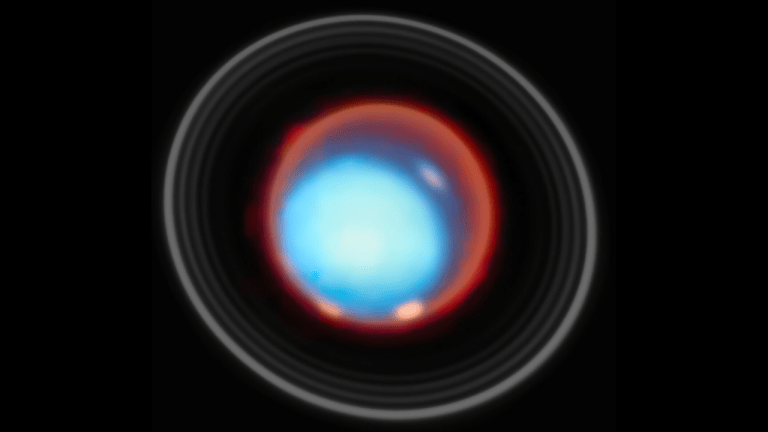
The distant, enigmatic ice giant Uranus has long held its secrets close, but thanks to the unparalleled observational prowess of the James Webb Space Telescope (JWST), humanity is now gaining an unprecedented perspective. In a groundbreaking new development, scientists have released the first-ever comprehensive uranus 3d view, revealing the planet's dynamic, spinning atmosphere and delving into the mysterious depths where its unique auroras ignite. This revolutionary mapping offers a never-before-seen look at the vertical structure of Uranus's upper atmosphere, unlocking critical clues about its energy balance and the strange mechanics of its magnetic field.
For the first time, astronomers have been able to trace the movement of energy and particles in three dimensions, providing a vivid depiction of how Uranus functions from its visible cloud tops to thousands of kilometers above. This isn't just a static image; it's a dynamic exploration, providing a video-like experience of the gas giant in rotation. The insights gleaned from this detailed observation are not only expanding our understanding of Uranus but also have profound implications for characterizing the myriad ice giants discovered beyond our solar system.
Unveiling Uranus's Atmosphere in Three Dimensions
The sheer scale and sensitivity of the James Webb Space Telescope have allowed researchers to achieve what was previously impossible: a full, three-dimensional reconstruction of Uranus's upper atmospheric layers. To accomplish this feat, a dedicated team observed Uranus for nearly one complete rotation, meticulously mapping the subtle glow of molecules high above the planet's cloud decks. This wasn't merely about seeing more; it was about seeing deeper, vertically, into the structure that governs Uranus's weather and energy distribution.
Paola Tiranti of Northumbria University, who spearheaded this ambitious study, emphasized the significance: "This is the first time we’ve been able to see Uranus’s upper atmosphere in three dimensions. With Webb’s sensitivity, we can trace how energy moves upward through the planet’s atmosphere and even see the influence of its lopsided magnetic field." This statement underscores the leap in understanding provided by Webb's capabilities.
The team utilized Webb's instruments to map the temperature and density of ions – charged particles – at astonishing altitudes, reaching as high as 5,000 kilometers (approximately 3,100 miles) above Uranus's atmosphere. This region, known as the ionosphere, is where the planet's atmosphere becomes ionized and interacts profoundly with its magnetic field. Key findings revealed distinct variations in these layers:
- Atmospheric temperatures were found to peak between 3,000 and 4,000 kilometers (roughly 1,860 to 2,485 miles) up.
- Ion densities reached their maximum around 1,000 kilometers (620 miles) in altitude.
These clear height variations within the atmosphere are not random; scientists suggest they are intrinsically linked to the ice giant's peculiar magnetic field, a topic we'll explore further. The ability to precisely map these vertical structures represents a monumental step forward, offering an unparalleled uranus 3d view that reveals the complex interplay of energy and matter in a distant world.
Decoding the Ice Giant's Lopsided Magnetic Field and Aurora Depths
Uranus stands apart in our solar system, not just for its peculiar sideways tilt but also for its truly bizarre magnetic field. Unlike Earth's relatively aligned magnetosphere, Uranus's magnetic field is dramatically tilted and significantly offset from its rotational axis. This creates a highly complex and dynamic environment, particularly visible in its dazzling aurora displays.
Webb's new observations have provided the most detailed view ever of these aurora-forming regions, illuminating how they are influenced by this strange magnetic geometry. Scientists detected two distinct bands of bright aurora near Uranus's magnetic poles, much like Earth's northern and southern lights. However, the intricacies didn't stop there. Researchers also identified a puzzling lack of emission and ion density in the region situated between these two aurora bands. This phenomenon is directly attributed to the convoluted paths of Uranus's magnetic field lines, which sweep across the surface in ways that are far from straightforward.
As Tiranti explains, "Uranus’s magnetosphere is one of the strangest in the Solar System. It’s tilted and offset from the planet’s rotation axis, which means its auroras sweep across the surface in complex ways. Webb has now shown us how deeply those effects reach into the atmosphere." This deep reach is crucial for understanding how energy is transferred throughout the planet and how its atmosphere interacts with the space environment. The detailed uranus 3d view from Webb helps us visualize these complex magnetic field interactions and their profound impact on the planet's atmospheric layers. For more in-depth analysis, discover how James Webb's 3D View of Uranus Reveals Atmospheric & Aurora Secrets.
A Chilly Revelation: Uranus's Cooling Trend Confirmed
Beyond the dynamic auroras and vertical atmospheric structure, the Webb observations have also confirmed a long-suspected atmospheric trend: Uranus is cooling down. This phenomenon has been noted by astronomers since the 1990s, but Webb's superior sensitivity and direct measurements provide definitive evidence. The telescope recorded an average atmospheric temperature of approximately 150°C (300°F). While this might sound warm, it is notably lower than temperatures previously recorded by ground-based telescopes and earlier spacecraft missions.
The confirmation of this cooling trend raises fascinating questions about the long-term climate dynamics of ice giants. What mechanisms are driving this cooling? Is it a cyclical process, or indicative of a more profound shift in Uranus's energy balance? Understanding the factors contributing to this temperature drop is vital for building accurate models of the planet's atmospheric evolution. Webb's ability to provide precise temperature mapping across different altitudes and over time makes it an indispensable tool for planetary climate science.
This cooling trend, coupled with the detailed uranus 3d view of its atmosphere, offers a more holistic understanding of this distant world. It highlights the importance of sustained observation and the power of advanced instruments like Webb to reveal subtle yet significant changes in planetary environments. For further insights into these fascinating discoveries, explore Uranus 3D View: Webb Maps Cooling Atmosphere & Mysterious Magnetic Field.
Why This Matters: Beyond Our Solar System
While a deeper understanding of Uranus is inherently valuable, the implications of Webb's findings extend far beyond our own solar system. Ice giants like Uranus and Neptune are thought to be among the most common types of exoplanets in the galaxy. By thoroughly characterizing Uranus – understanding its energy balance, atmospheric dynamics, and magnetic field interactions – scientists gain invaluable data points for interpreting observations of exoplanets that are far too distant for direct, detailed study.
The detailed vertical mapping of Uranus's atmosphere helps researchers refine models for atmospheric circulation and energy transport in similar planetary bodies. The insights into how Uranus’s unique magnetic field influences its auroras and upper atmosphere provide a template for understanding magnetic processes on other ice giants, which could play a crucial role in habitability or atmospheric retention. Essentially, Uranus serves as a close-by laboratory, allowing us to test theories and build frameworks that can then be applied to planets thousands of light-years away.
Furthermore, the ability to confirm and monitor long-term atmospheric changes, like the cooling trend, enhances our understanding of planetary evolution itself. This knowledge is not just academic; it informs our search for life beyond Earth by helping us identify planets that might possess stable atmospheres and conditions conducive to life. Webb’s capabilities truly bridge the gap between observing our cosmic neighbors and deciphering the mysteries of distant worlds.
Fascinating Facts about Uranus:
- The Sideways Planet: Uranus is unique for rotating almost completely on its side, with an axial tilt of 98 degrees. This extreme tilt results in incredibly long, unusual seasons.
- An Ice Giant: Despite being a "gas giant," Uranus is primarily composed of various ices (water, ammonia, methane) over a rocky core. It's often referred to as an "ice giant."
- The Coldest Planet: Surprisingly, Uranus holds the record for the coldest planetary atmosphere in the Solar System, with temperatures dropping as low as -224 °C (-371 °F) in its cloud tops, despite being farther from the Sun than Neptune.
The first uranus 3d view provided by the James Webb Space Telescope marks a pivotal moment in planetary science. By mapping the vertical structure of its atmosphere, observing its dynamic auroras, and confirming its cooling trend, Webb has peeled back layers of mystery surrounding this distant ice giant. These discoveries not only deepen our appreciation for the complex processes at play within our own solar system but also equip us with essential tools for exploring and understanding the vast diversity of exoplanets across the cosmos. The ongoing work with Webb promises even more revelations, continually pushing the boundaries of our cosmic understanding.